Six strategic realities to stay relevant in the German outdoor market

Uppdaterat: 20 dec. 2025
FROM EXPERIENCE COLLECTORS TO NATURE GUARDIANS
Six strategic realities brands must understand to stay relevant in the German outdoor market
The outdoor category is going through a shift that is easy to feel but harder to articulate.
Consumers haven’t abandoned outdoor life. They haven’t become less active. And they haven’t stopped caring.
What has changed is why they engage, how they relate to nature, and what they expect brands to contribute.
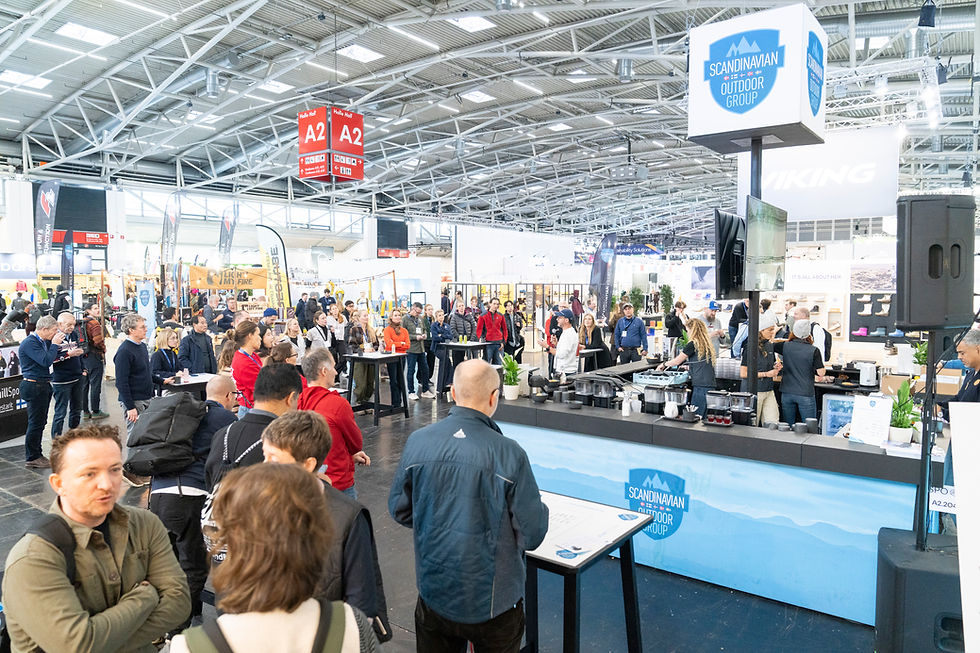
During the Buyers Breakfast talk at #ISPO Munich arranged by #ScandinavianOutdoorGroup #Ninyes and #MiniATure, I shared insights from Above The Clouds’ Future Series to frame this shift clearly. Not as trends. Not as predictions. But as six strategic realities that brands need to understand in order to stay relevant in Germany and across Northern Europe.
This article walks through those realities, the consumer logic behind them, and what they mean for brand positioning, communication, and activation.
If you want to explore what this means specifically for your brand, this framework is also the basis for my bespoke company presentations and Insights & Strategy Sprints. More on that at the end.

1. Emotional drivers are becoming stronger than age, gender and activity
In the NXT Outdoor Consumer Report Germany, built on 1,300 respondents and compared with the NXT Outdoor Consumer Nordics study with 2,500 respondents, one pattern stood out clearly.
Demographics still matter. Activities still matter. But emotional drivers and mindsets now play a stronger role in shaping behavior.
People move between needs depending on life phase, pressure, social context, and mental load. The same individual can seek intensity, freedom, family time, and responsibility, often within the same month.
This is not inconsistency. It is a rational response to a complex world.
Above The Clouds’ Future Series, has (since 2020) tracked this development annually across the NXT Sustainable Consumer and NXT Outdoor Consumer reports. What we see is a steady shift towards adaptive behavior, where consumers use outdoor life differently depending on need, emotionally and occasionally.

2. Three archetypes shaping German outdoor behaviour
During the talk, we explored three key archetypes that define today’s German outdoor consumer landscape. These are not personas to target but mindsets to understand.
Experience Collectors Driven by living-for-now energy. Outdoors becomes intensity, emotion, and release. It is not about optimization but about feeling alive in a pressured everyday life.
Flexible Freedom families Outdoor life is adaptability. Less rigid planning, more room for real life. Camping, hiking, and simple adventures that can stretch or shrink depending on time, energy, and family dynamics.
Nature Guardians Here, outdoor engagement strengthens the desire to protect nature itself. Biodiversity, longevity, and responsibility matter deeply. Nature is not a backdrop; it is the value.
The strategic implication is not to choose one archetype but to map these mindsets and translate them into clear brand positioning, communication, and activation strategies.
This is where a winning game matrix becomes essential. One brand. Multiple mindsets. Clear rules for how, when, and where you show up.

3. Six focus areas brands can’t ignore
Based on the insights we work with across the Future Series, we presented six focus areas that brands need to take seriously. These are not trends to chase, but strategic realities to respond to.
They reflect how consumers think, feel, and behave today, and where brands risk becoming irrelevant if they don’t adapt.

1) Living-for-now-ism
Driven by pressure, uncertainty, and future fatigue. Consumers prioritize presence, emotion, and intensity. In Germany, this shows up as shorter planning horizons and a higher value placed on meaningful experiences now.
2) Flexible Freedom
Families and individuals want outdoor life that adapts to them. Not fixed formats, but flexible frameworks that allow nature connection without friction.
3) The NXT Creative Collectives
Cultural pioneers are reshaping how outdoor life looks and feels. More on this below.
4) From Signal to Substance
A clear shift away from vague positioning towards concrete action, clarity, and proof.
5) Sustainability Paradox
Still emotionally important, but only when it is tangible, focused, and credible.
6) Second-hand as Business Case
Secondhand is no longer niche. It functions as a trust signal, a longevity proof, and a relationship builder between brand and consumer while creating new business.
Taken together, these six areas form a strategic lens brands can use to assess where they are aligned and where they are out of sync with consumer expectations.
4. The NXT Creative Collectives: from run clubs to outdoor culture
This shift deserves special attention. Around 2020, run clubs became a cultural hotspot. Social, accessible, urban. Today, those same cultural pioneers are moving further.
They are becoming outdoor clubs.
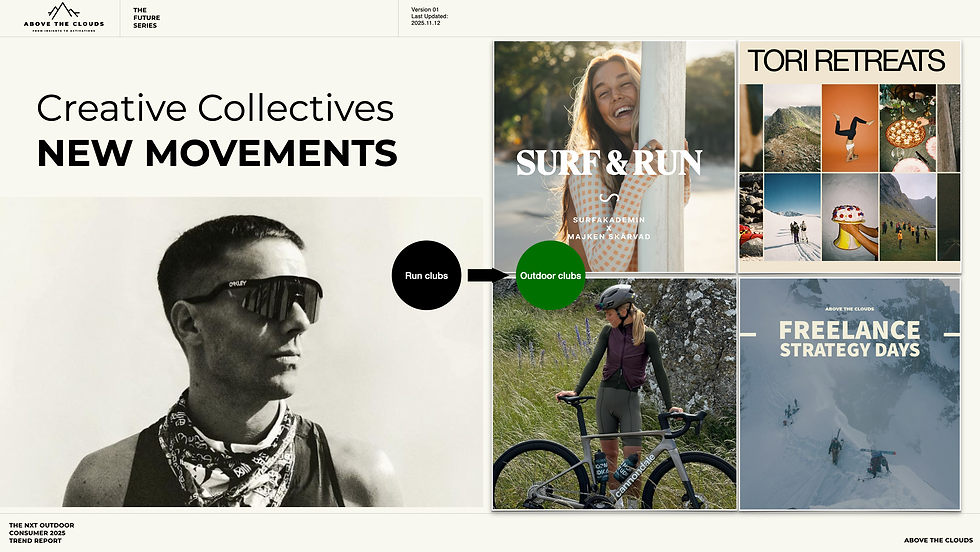
Why? Because run clubs became mainstream. Because nature offers deeper rewards. And because testing yourself in less predictable environments creates stronger meaning and connection.
Outdoor gear and outdoor wear, especially in urban settings, now function as social status signals. They say, "I belong to this culture. in the same way as Hermes does in other communities."
What truly sets these collectives apart is their attraction to hybrid activities: Hike ’n Bike. Surf ’n Run. Ski-Tour ’n Yoga.
This is not about performance. It is about variety, creativity, and identity.
For brands, success here is not about hosting culture but about understanding how to participate in it. Knowing when to support, when to collaborate, and when to simply enable without over-branding.
5. From signal to substance: why this shift is happening now
“From Signal to Substance” is not just a communication trend. It is emotionally driven.
It is closely connected to Future Fatigue and the Sustainability Paradox.
Consumers care deeply about sustainability, but feel overwhelmed, judged and unsure whether their actions matter. Over time, this creates fatigue. Big promises start to feel hollow. Broad narratives lose credibility.
What people want now is clarity. Fewer actions, done well. Transparency over storytelling. Repair, reuse, longevity and biodiversity over slogans.
Secondhand plays a crucial role here. It turns sustainability into something visible and practical. Not a virtue, but proof.
Substance builds trust. Signals do not.

6. What brands should take with them
To close the talk, we summarized the shift into clear mental takeaways. These align directly with the six focus areas.
Living-for-now-ism: Design communication and activation for emotional relevance today, not just future promises.
Flexible Freedom Remove friction. Make outdoor life easier to enter, adapt and repeat.
Creative Collectives understand cultural pioneers and hybrid behaviors before they become mainstream.
From Signal to Substance Be precise. Do less, but do it clearly and consistently.
Sustainability Treat it as credibility, not virtue.
Second-hand See it as a trust system, not a side project.
For brands that want to translate these insights into action, this is exactly where an
If you want to dive deeper, let's do an Insights & Strategy Sprint that creates value. Mapping your brand against these realities, identifying gaps, and building a clear Winning Game Matrix.
7. Why this matters now
Outdoor brands operate in a category built on trust, nature, and long-term relevance.
Understanding these shifts is not about chasing the next idea. It is about creating real value for people, aligning with how they actually live, and earning the right to stay relevant.
If you want to explore what this framework means for your brand, team, or market, I work with companies through bespoke presentations and Insights & Strategy Sprints based on the Above The Clouds Future Series.
Reach out, and we’ll take it from insight to action.


Kommentarer